
Haute St. Clair: Interior Design Lexicon
An Online Educational Glossary of Interior Design Terminology
Haute St. Clair presents the Interior Design Lexicon: an original, educational reference created to define, contextualize, and standardize commonly used terminology within the field of interior design. This lexicon is designed for students, emerging designers, industry professionals, and design-literate clients seeking clarity around professional language used in interiors, architecture, and decorative arts.
Purpose & Scope
The Interior Design Lexicon exists to:
Provide clear, concise definitions of interior design terminology
Preserve professional language and historical references within the discipline
Support design education and literacy
Serve as a centralized reference for concepts spanning residential, commercial, and hospitality interiors
Definitions may include historical context, functional explanations, professional usage notes, and example applications.

Bas Relief
Lexicon Entries Organized by Use with Expanded Terms
1. Design Principles & Composition
Aesthetic: The visual and sensory principles guiding the appearance of a space. See also: Balance, Contrast, Proportion.
Application: Selecting a cohesive color palette and coordinating furniture finishes.
Balance: Visual distribution of weight within a space; can be symmetrical, asymmetrical, or radial. See also: Proportion, Scale.
Application: Arranging seating and tables in a living area to create visual stability.Contrast: Deliberate juxtaposition of differing elements to create emphasis and visual interest. See also: Aesthetic.
Application: Combining smooth marble surfaces with textured fabrics.Hierarchy: Intentional ranking of spaces or elements by importance or visual prominence. See also: Scale.
Application: Designing a grand foyer that draws attention as the entry point of a home.Proportion: Relationship between elements in a space relative to one another and the whole. See also: Balance, Scale.
Application: Choosing furniture that complements ceiling height and room dimensions.Scale: Perceived size of an element relative to the human body or surrounding context. See also: Proportion.
Application: Ensuring that oversized seating does not overwhelm a small apartment.Negative Space: Unoccupied areas that provide visual relief and emphasize surrounding elements. See also: Balance.
Application: Leaving empty floor space around a central coffee table to enhance circulation.Composition: The deliberate arrangement of visual elements within a space or artwork. See also: Montage, Aesthetic.
Application: Organizing furniture, lighting, and art in a living room to create a cohesive visual flow.Montage: The assembly of multiple images, materials, or objects to communicate a unified design concept. See also: Composition.
Application: Combining photographs, fabric swatches, and paint samples on a design board.
2. Space Planning & Function
Circulation / Circulation Path: Planned flow of movement within a space. See also: Spatial Planning.
Application: Designing a retail layout that guides customers intuitively through product zones.Spatial Planning: Strategic organization of rooms, zones, and functions. See also: Circulation.
Application: Allocating separate areas for dining, living, and workspace in an open-plan home.Programmatic Requirements: Functional needs and spatial criteria informing interior layouts. See also: Spatial Planning.
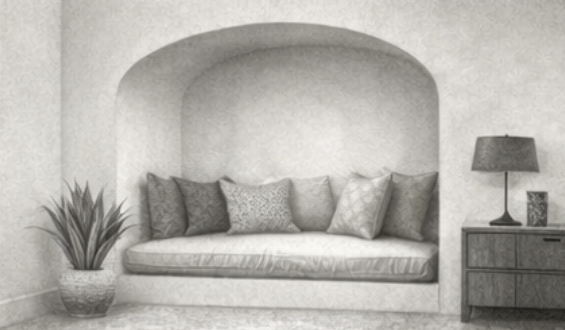
Application: Ensuring a hotel lobby accommodates reception, seating, and baggage handling efficiently.Alcove: A recessed area within a room, often used for seating, display, or sleeping.
Application: Creating a reading nook in a bedroom or living area.Modular Seating: Configurable seating units that can be rearranged to suit different spatial needs.
Application: Using sectional sofas in a flexible living room layout.Jib Door: A concealed door flush with wall paneling, often used for seamless architectural design.
Application: Hiding a utility closet behind a living room wall.Loggia: A covered exterior gallery or corridor, often open on one or more sides.
Application: Providing shaded outdoor circulation along a building facade.
3. Furniture & Fixtures
Casegoods: Furniture primarily made of rigid materials like wood or metal. See also: FF&E.
Application: Selecting a mahogany dresser for a master bedroom.FF&E (Furniture, Fixtures & Equipment): Collective term for movable furniture, fixed fixtures, and operational equipment. See also: Casegoods.
Application: Specifying all furnishings and lighting for a boutique hotel suite.Joinery: Methods of connecting components in furniture, millwork, or architectural elements. See also: Material Authenticity.
Application: Choosing dovetail joints for drawers to ensure durability and craftsmanship.Conduit: Tubing or channels used to protect electrical wiring or other utilities within a building.
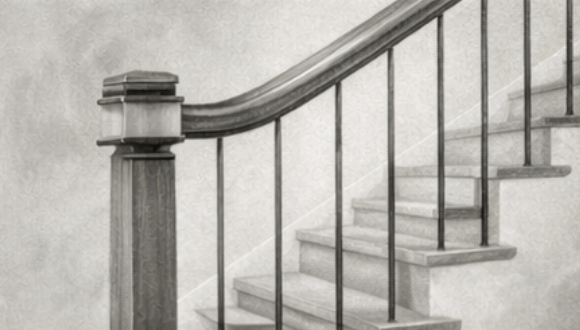
Application: Installing electrical conduit in walls for safe wiring routing.Banister: The handrail and supporting posts along a staircase.
Application: Selecting a wooden or metal banister to complement stair design.
4. Materials & Material Use
Materiality: Intentional selection of materials based on visual, tactile, and performance qualities. See also: Material Authenticity.
Application: Combining stone, glass, and wood for a multi-sensory lobby experience.Material Authenticity: Honest expression of materials according to inherent properties and construction methods. See also: Joinery.
Application: Leaving natural wood grains exposed rather than covering with veneers.Lacquer: A durable, glossy finish applied to wood or metal surfaces.
Application: Coating cabinetry for a high-gloss aesthetic.Damask: A patterned woven fabric, often reversible, used for upholstery or drapery.
Application: Upholstering dining chairs with a damask fabric for formal elegance.Grain: The natural pattern or texture of wood or other fibrous materials.
Application: Aligning wood grain in furniture panels for visual continuity.Inlay: Decorative insertion of contrasting materials into a base surface.
Application: Embedding mother-of-pearl into a tabletop for ornamentation.
5. Architectural Elements & Details
Architectural Detail: Constructed elements contributing to the character of a space, e.g., moldings, trim. See also: Ornamentation.
Application: Installing crown moldings to enhance the elegance of a formal dining room.Axis: Implied or explicit linear reference organizing spaces or elements. See also: Hierarchy.
Application: Aligning a corridor with a central focal point in a gallery.Fenestration: Arrangement and design of openings such as windows and doors. See also: Materiality.
Application: Positioning windows to maximize daylight and exterior views.Ornamentation: Decorative elements enhancing visual richness or stylistic identity. See also: Architectural Detail.
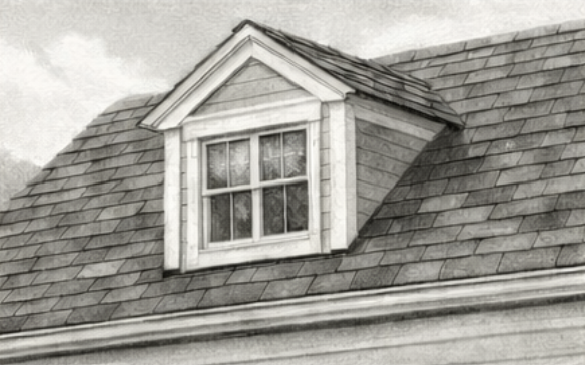
Application: Adding carved wood panels to a historic reception room.Dormer Window: A vertical window projecting from a sloped roof.
Application: Adding light and headroom to an attic space.Eaves: The edges of a roof that overhang walls.
Application: Designing extended eaves to protect exterior walls from rain.Elevation: A drawing showing the vertical plane of a building or interior wall.
Application: Creating elevations for a kitchen cabinet layout.Entablature: The horizontal structure supported by columns, including architrave, frieze, and cornice.
Application: Designing classical facades using proper entablature proportions.Entasis: Slight convex curvature in columns to correct optical illusion of concavity.
Application: Designing Doric columns with entasis for classical accuracy.Fascia: The horizontal board covering the edge of a roof.
Application: Installing fascia to conceal gutter attachments.Keystone: The central stone at the apex of an arch, locking it in place.
Application: Highlighting the keystone for decorative effect.Fan Vaulting: A ceiling design in which ribs spread out in a fan-like pattern.
Application: Using fan vaulting in a Gothic-inspired chapel.Mullion: Vertical or horizontal element dividing windows.
Application: Designing multi-pane windows with wooden or metal mullions.
6. Historical & Stylistic Context
Baroque: A highly ornate and dramatic style of art and architecture originating in 17th-century Europe.
Application: Designing a Baroque-inspired interior with gilded moldings and elaborate furnishings.Diptych: A two-paneled artwork, often hinged and intended for devotional or decorative use.
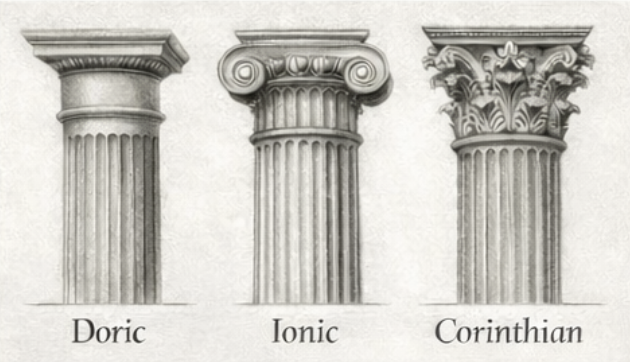
Application: Hanging a diptych painting over a console table.Doric Order: The simplest of the classical Greek column styles, characterized by fluted shafts and plain capitals.
Application: Using Doric columns in a neoclassical building facade.Ionic Order: A classical column style distinguished by volutes on the capital.
Application: Specifying Ionic columns for a formal entry porch.Corinthian Order: The most ornate classical column style, featuring acanthus leaves on the capital.
Application: Applying Corinthian columns to a grand hall.Greek Revival: A 19th-century architectural movement drawing inspiration from classical Greek forms.
Application: Designing a portico with Greek Revival columns.Neoclassicism: A revival of classical architecture and design principles emphasizing symmetry and simplicity.
Application: Planning a neoclassical interior with restrained ornamentation.Trompe l'oeil: A painting or decoration technique that creates the optical illusion of three-dimensionality.
Application: Painting faux architectural features on a flat wall surface.Haut Relief: Sculptural technique where figures project significantly from a background.
Application: Installing a haut relief panel as an accent wall.Bas Relief: Sculptural technique with shallow carving projecting slightly from the background.
Application: Using bas relief on a fireplace surround.Iconograph: The study or depiction of symbols, images, and motifs in art and design.
Application: Incorporating symbolic motifs into decorative textiles.
7. Additional Architectural Elements & Techniques
Convolute: Spiral or coiled ornamental forms often found in classical architecture.
Application: Designing spiral scrollwork on column capitals.Conventionalization: The abstraction or stylization of natural forms for decorative use.
Application: Stylizing floral motifs in wallpaper design.Incise: To cut or carve a design into a surface.
Application: Incising patterns into wood paneling.In Situ: Artworks or architectural elements located in their original position.
Application: Preserving a mural in situ during a renovation.Lattice: An open framework of crisscrossed strips, often used in windows, screens, or partitions.
Application: Installing a lattice partition to divide spaces while maintaining visibility.I Beam: A steel structural member shaped like the letter “I,” used in modern architecture.
Application: Supporting a mezzanine floor with exposed I beams.Glyph: A carved or inscribed symbol or character, often decorative or communicative.
Application: Including glyph motifs in friezes or tile patterns.
Educational Use Notice
The Haute St. Clair: Interior Design Lexicon is provided for educational and informational purposes only. Content is original to Haute St. Clair and reflects professional industry usage at the time of publication.
Alcove
Banister

Inlay
Dormer Window
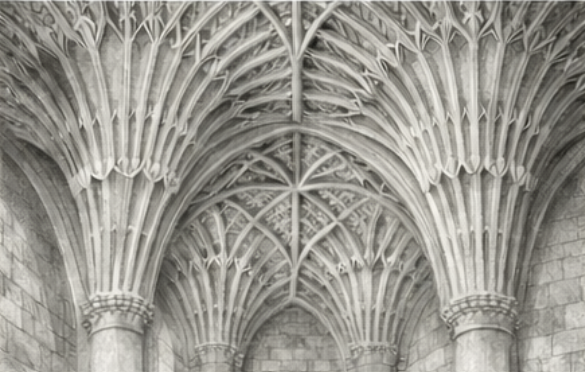
Fan Vaulting
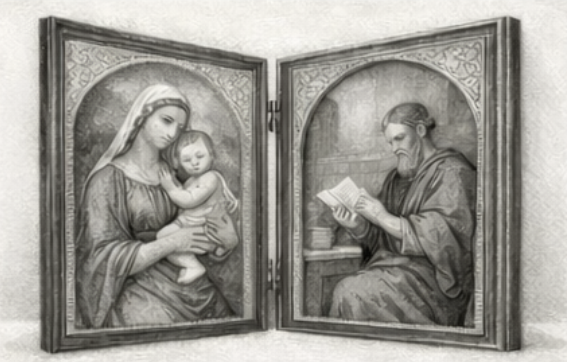
Diptych

Tromp L’oeil